Saturday, October 22, 2011

Thanksgiving

November fifth is butchering day at Rise 'N' Shine Farm. I will miss my feathered friends. They follow me around the farm like dogs. Although, I believe Rufus (A White Holland) and his girlfriend will stay and reside as part of the farms ambiance. Rufus won his way into my heart at two days old when he would drop his wings, strut and turn in a circle. His daily dignified dance has captured my attention and won a place in my heart. He has never been forceful with his demeanor like some of the other males, but proudly displays his presence with a dignified honor.
It’s hard to believe that Thanksgiving is around the corner. After raising turkeys, we truly know the depth of the meaning of Thanksgiving. I have not been sheltered from the process of life and understand it's deeper significance. I often times correlate the nurturing, care, love and sacrifice that goes into raising an animal with the life of our Lord and Savior. Thank you Lord for blessing me with joy and understanding and for the gifts that you have richly bestowed upon me. Thank you for your sacrifice and for loving me enough to save me and bless me with a heavenly home to spend with you in eternity. I am truly thankful.

Romans 10:9 (KJV
9That if thou shalt confess with thy mouth the Lord Jesus, and shalt believe in thine heart that God hath raised him from the dead, thou shalt be saved.

Wednesday, October 19, 2011

The Finer Things in Life

We had a wonderful day of gathering together with some ladies and one gent for a workshop on sprouting grain and making homemade bread, biscuits, sweet rolls and pizza. We topped it off with learning how to make homemade butter from the inspiration of my Great Grandmother Emma's prize winning homemade butter.
As the conversation spun it's web into homemade goodness and the shift of healthy living alternatives, we were all in agreement that the small farm could be kept sustainable for the future health of our rural and suburban families. The reality that big farms have had to use pesticides and the worlds alternatives in competing to produce more to stay in existence. The trend to purchase grass fed meat and organic veggies has put the small farm back on the map with the possibilities of squeezing it's way back into a sustainable crevice.
We still have a way to go for those who are seeking to purchase our small farm products. We are still competing with the Walmart mind set of more bang for our buck with out the considerations that the small farmer and his or her passion does not pay for the increase in organic feed. A quick example would be a regular bag of turkey feed would cost $11.95 and an bag of no GMO turkey feed is $18.00. When finishing twenty-six Thanksgiving birds the last two months of their lives, we are going through a fifty pound sack of feed every other day. This gives zero profit for no hormone, no pesticide, no GMO farmer. It does not take into consideration for the time spent changing newspaper like diapers for sanitation and the health of the baby bird. No paycheck for their daily care of feeding and watering and shoveling manure. There is no compensation for the gas that is spent to purchase organic feed that often times cannot be obtained at your usual local feed dealer. Yes, it has to be a passion to free range a bird and patiently herd it back from across a fence and from the nearest neighbors tree. You can bet your bottom dollar, that I will be thankful at our Thanksgiving feast.
There still can be a more with less exchange when you are not paying for doctors visits and your food cravings decline because you have shifted to eating real food just like Great Grandma. This took place long before the drive through was installed for our convenience or for our slow demise.
A new appreciation for healthy food needs to be talked about and discussed with our children. They need to learn to appreciate the finer things in life.
Spend a day helping do chores with your local farmer.
Ask if you can attend butchering day.
Learn where your food comes from, what it eats and the care it is given before it ever reaches the convenience of your table.
Teach your children to understand the depths of how their Great Grandparents lived.
Encourage them not to forget their roots and teach appreciation as they move forward in this face paced world. Convenience like greed has a much higher price to pay.

Cheryl's Turkey Dressing

Ingrediants:
Cook down giblets (heart, liver & gizzard) Chop and add broth to ingrediaents
4 cups chopped celery
1 cup chopped sweet onion
1 cup melted butter
4 quarts or 16 cups of homemade dried & cubed bread crumbs
1 Tablespoon sea salt
1 1/2 teaspoons poultry seasoning
1/2 teaspoon sage
1/2 teaspoon freshly ground black pepper
Cayenne pepper to taste
Whisk 2 eggs
Warm Chicken or turkey broth

Directions:
Add the above ingredients to a mixing bowl.
Add broth to desired consistency.
Place in a Pyrex baking dish.
Cook at 350* for 20 minutes covered and 15-20 minutes uncovered to brown sufficiently.
This recipe makes enough dressing to serve with a 14-18 pound turkey.

Wednesday, August 31, 2011

My Two Scents

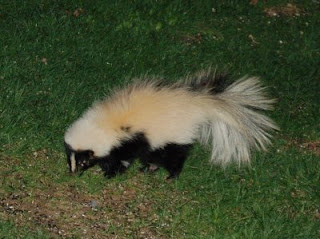
Each night, I journey to secure the chickens and turkeys from visiting predators. When I was gathering the remnant of straying turkeys from the back of their shed, I spotted a mound of freshly unearthed dirt. My natural assumption was that it was the usual visiting ground hog. I fetched and baited my live trap and set it next to the shed. The next morning when I went to check the trap, I could see from a distance that the trap door had been tripped. With much certainty, I neared to view what I thought would be a ground hog but to my surprise, I had caught a skunk. I stopped dead in my tracks and approached with caution. This was not the usually variety that we see, but a white skunk with a black underside. I quickly processed the event and decided that he was probably trying to dig under the shed to reach the turkeys food, but to no avail. We had diligently buried wire to prevent such measures. Like raccoons, skunks carry rabies. This was not something , we wanted to hang around our farm. I gathered as much information and contacted other locals that could tell me how to dispose of this perfumed critter. I was told to approach it at night with a flash light to blind it and cover it with a heavy blanket. Next, to fill a tub with water or take it to the creek and drowned it.
We set out that night with all our gear in hand and our prepared water filled barrel for his demise. After blinding him and covering him, we slowly and carefully drug him to the barrel. Upon lifting him in the air and lowering him to the water, we discovered that the cage did not fit the rounded water filled brim. Defeated, we left him in the cage and returned the next night for plan B. This time, we decided to back the truck up over the top of the cage and let the exhaust slowly lull him into eternal sleep. The next morning, we arrived to dispose of the poor creature, we were surprised to find a happy and much alive skunk. I was exhausted by the emotion of trying to rid myself of this helpless creature, so I did what most would do. We set him happily free. We watched as he tipped his head and listened to our voices, then slowly moved from his caged existence and quickly scurried into the neighboring wooded terrain.


How to Catch a Skunk

Shine a flashlight in their eyes at night. It will blind them. Pick them up by the tail. This prevents them from spraying. Put them in a box with a lid that is kept in the dark for transport.

Skunk in a live trap
Shine a flashlight in their eyes as you are approaching. Cover with a heavy blanket. Re-locate miles from your home or take to the nearest body of water and immerse the trap for six minutes or better.

Little Known Facts
The scent gland is sold to high end perfume companies to help hold the scent.

De-Skunk Shampoo
In a plastic bucket mix the following ingredients
1 quart of 3% Hydrogen Peroxide
1/4 cup of baking soda
1 to 2 teaspoons liquid soap
for very large pets one quart of tepid tap water may be added to enable complete coverage.
Wash pet promptly and thoroughly, work the solution deep into the fur. Let your nose guide you, leave the solution on about 5 minutes or until the odor is gone. Some heavily oiled areas may require a "rinse and repeat" washing.
Skunks usually aim for the face, but try to keep the solution out of the eyes - it stings. If you have any cuts on your hands you might want to wear latex gloves for the same reason.
After treatment, thoroughly rinse your pet with tepid tap water.
Pour the spent solution down the drain with running water.
NEVER, ever, store mixed solution in a closed bottle, sprayer, etc. Pressure will build up until the container bursts. This can cause severe injury.

Notes
1) Clean plastic mixing containers and utensils are preferred. Metals encourage auto-decomposition of the peroxide.
2) Hydrogen Peroxide 3% solution is usually sold in pint (500ml) bottles, so you'll need two. The 3% grade is often marked "U.S.P.", meaning that it meets the standards for medical use and purity as set forth in the United States Pharmacopoeia.
The use of other strengths/grades is not recommended unless you're a chemist, and even then a trip to the 24-hour drugstore is much better than a trip to the emergency room.
3) Use baking soda, not baking powder. "Arm and Hammer" is one popular brand. Baking soda is also called: Sodium Bicarbonate, Sodium Bicarbonate, U.S.P., Bicarbonate of Soda, and Sodium Hydrogen Carbonate. Do not confuse any of the above with Washing Soda, which is Sodium Carbonate. Washing Soda is about 100 times more alkaline than Baking Soda and can cause skin burns to both you and your pet.
4) Two preferred brands are "Softsoap" and "Ivory Liquid". As far as auto-decomposition of the peroxide is concerned, the surfactant package in these two is fairly inert. Heavy-duty grease-cutting brands such as "Dawn" are less inert, and hair shampoo is probably the worst.
5) Once mixed, the peroxide slowly breaks down into water and oxygen gas. Thus it gets weaker with time and so it should be used promptly. The exact rate depends on temperature, pH, and catalysts such as trace amounts of metals (iron, etc.) in the soap and/or tap water.
How much pressure will the complete decomposition of 3% hydrogen peroxide produce in a closed container ??? It depends on how full the container is. Assuming negligible solubility of Oxygen in water, a bottle half-full of peroxide will develop about 140 psi. A bottle 3/4 full would develop 420 psi. This can do a lot of damage.
Highly pure hydrogen peroxide decomposes very slowly if kept cool and in a dark place, a few percent a year. The more dilute solutions usually decompose faster (due to impurities in the dilution water) and have a trace of stabilizer added. So why aren't the bottles in the store bloated or bursting ? Look carefully inside the cap... you'll see some very tiny holes in the cap liner to let the oxygen gas escape. A good reason to always store bottles upright.
Look for an expiration date on your peroxide. If you're using stuff which has been sitting around in your medicine cabinet for years, buy fresh peroxide.
6) Tepid: lukewarm.
7) All brand names mentioned in this website are trademarks of their various owners.

Saturday, August 20, 2011

The Barn

When we first arrived in Pennsylvania the culturally differences from the West were obvious. The rolling hills and evergreen trees were bountiful. The Amish were scattered in various areas and their plain life was refreshingly reminiscent of yesteryear.
It is not uncommon to be greeted by Pennsylvanians and asked, if you want to see their barn, rather than their house. A barn in Pennsylvania is still highly valued. It's a safe haven where your animals are raised. A shelter to protect ones provision of hay and grain from the long bitter winter. Crops can be fed to sustain your animals or sold for those who are unable to plant. The majority of ones life is spent in the field and in the barn. The barn is still the central and most important part of every Pennsylvania farm.
So, when your welcomed by a Pennsylvania farmer's, "Come on in", don't expect to be taken into their parlor, but rejoice if your invited to view their true splendor that is showcased by an abundance of golden straw.

Saturday, August 13, 2011

The Note

When God sets a passion in your heart there seems to be no denying what just comes naturally. When you have something you love, what is known as work does not contain drudgery but true joy. Well not to say, that work is not involved but the heart reigns over the mundane tasks of labor.

Our first home was a small two bedroom one bath house. The bathroom was so small, that I referred to it as the two bedroom-no bath home. It was on the outskirts of Phoenix and was just 1/3 of an acre but for me it was my first glimmer of what I dreamed, a real farm. Even though the house was the size of a puddle, it was my goal to make it a pond.

Answering an add in the newspaper for chickens, we drove our old Buick to a rural surrounding farm that was selling out and moving to Texas. I drank in the thought of living the life that they had embraced. Growing up with the stories of my Great Grandmother and Grandfather that homesteaded one-hundred and sixty acres in Idaho, I longed to be surrounded by dirt. I was met by a handsome young man that was the son of the owner. He could see my excitement as I picked out a box full of laying hens from his flock. I graciously paid him and we put them in a cardboard box for the ride home. Not knowing a lick about chickens or farm animals for that matter, I did not shut the lid of the box. It was not long that I had a backseat full of full sized, fluttering chickens throughout our car. I’m certain we were a sight to behold.

Our small little house was bursting at the seams. Christin and Kati shared a bedroom and on weekends Candice would come to stay. Our son Dustin had arrived and slept in our bedroom and later would take the couch, as there was no more space for another bed. We were packed like sardines in that little house but all the kids in the neighborhood would make there way over to play at our house. There was more than one occasion that I would find a neighboring child asleep on our couch. A small unobtrusive house with no glitz or glamour that the neighborhood children seemed to see as a safe haven. A home, away from home.

It was not long that word seemed to spread of my love for animals. I took in strays and doctored flightless birds. I remember, one occasion of coming home and finding a dead bird placed on our doorstep with a note attached.

Cheryl,

I found this bird and thought you could bury it.

Love,
Amy

The sweetness of thinking that I was the only one that could properly dispose of this lifeless creature, touched my heart. The sweet innocence of a child resembled that which I had found among my animal friends. A lesson that I will cherish all of my days.


Wednesday, July 13, 2011

Even the Smallest of His Creatures

Our neighbor asked, if I would be willing to take one of their baby ducks. It had been trampled by the other adult ducks and one of their chickens was protectively keeping him from getting any food. I was ecstatic because Indian Runner Ducks are my favorite breed of ducks. When I inspected the depths of this little ducklings injury, I was not very hopeful. Indian Runner Ducks hold their bodies upright like little penguins. Without the use of one leg there would be no possible way for this little duck to be able to survive. After little contemplation, we decided that it was worth at try. I went on line and found out how to make shoes to spread its webbed feet and splint it’s legs. The one leg and foot looked hopeful, while the other dangled like a piece of limp spaghetti. There was without a doubt severe nerve damage. My next focus was to give it a boost in nutrition. I added sugar, vitamins, and electrolytes to its water. I gave it free choice game bird feed. I found that if I picked around in the feed with my fingers it gave the duckling the sensation of the mother eating with her. My greatest concern was when I would return to check on her, her one leg would be laid out directly behind her. I was adamant to keep a vigilant eye and keep re-situating the leg into it’s proper position. About a week went by and I felt it was time to remove the splints for inspection. The one leg looked perfect while the other leg had made some progress but not enough for it to even stand. My greatest fear was that now that I had bonded, we would have to humanly put her down. I cried out to God, knowing that if it was His will, He could even heal the smallest of His creatures. The next day, I awakened to check on my little feathered friend. My heart was low as I was beginning to except her unimaginable fate. When I looked in the box, she was trying to stand on her leg. Prayers of praise and tears of joy from this two legged mama duck. There was hope for her survivability. A miracle for one of God’s creatures. As the days went by her leg strengthened, we began to take short little walks. Her little leg went to one side and her webbed foot pointed inward, but she waddled with the utmost of determination. Every morning when I open our chicken coops, Inga runs along side of me to do our chores. We stop to take a break under the oak tree and she gets a bite to eat. On our way back to the house, I help her into the water trough and relish in the joy of watching those little webbed feet swim. Inga is a constant reminder that God is faithful to even the smallest of His creatures.

Do Not Worry
25Therefore I say unto you, Take no thought for your life, what ye shall eat, or what ye shall drink; nor yet for your body, what ye shall put on. Is not the life more than meat, and the body than raiment?
26Behold the fowls of the air: for they sow not, neither do they reap, nor gather into barns; yet your heavenly Father feedeth them. Are ye not much better than they?
27Which of you by taking thought can add one cubit unto his stature?
Matthew 6:26-27 (KJV)

Saturday, July 9, 2011

Billy Boy

The spring and summer months have always offered me joy. Spring for me means new life. On the farm new life is abundant with the birth of a variety of baby animals. A joy that I simple will never tire. While at the Farm Show last year my husband and I purchased a blue eyed white male peacock to keep our white female hen company. We house them in the barn for the winter and let them into the back treed area to reside with the chickens in the summer months. David cut paths with the tractor but left the field with a natural landscape. I piled branches in one area for the wild rabbits to reside. A place that I refer to as the Rabbitatury. Yes, a word that I made up but is fitting for their mini wilderness area. I love walking out back and seeing the wild rabbits, peacocks. llamas, alpacas, and Jacob Sheep all meandering through the high blades of foliage, pine and cedar trees. A tranquil oasis to have a quiet time of reflection and thank God for what he has provided for our enjoyment. One evening, we noticed that we had not seen our blue eyed white male peacock but could hear him calling in the distance. Living a stones throw from the Conewago Creek, I was certain that Billy Boy was enticed by his adventurous spirit. The next morning, we received a call from a neighbor that Billy had made his way to their chicken coop and was happily residing with their chickens and ducks. We picked him up by wrapping him in a couple of towels for the ride home. We checked on how to adequately trim his flight feathers in hopes that this would keep him home bound. This still enabled him to fly short distances and get into a tree for his safe keeping at night. Several days passed and Billy and Iola remained together. Just about the time, I thought we had the situation conquered, the phone rang to let us know that Billy was walking down our road and up the dirt road that leads to our neighbors coop. No longer able to take flight, he decided to take the long hike on foot. These summer days we find that Billy Boy comes home for short visits and sleeps in the tree in the front field and then for no apparent reason, he takes his hike down the road and up the hill to visit his other favorite flock

Peacocks
Because of their gorgeous appearance, the peacock has long been famous outside of its native countries of Southern Asia and Malaysia. They have been kept for centuries by people first in China and then in Europe and America. The Phoenicians brought the peacock to Egypt more than three thousand years ago. Historical records indicate that Solomon kept several peacock species, among other pheasants, with the India Blue being his favorite peacock. Peafowl were extensively raised by the Romans for the table as well as for ornamental purposes, and medieval Europe carried on this practice as well. It is only after the XVI Century, when turkeys were imported from Mexico, that the peacock was discarded as a table bird for the more fleshy American birds.

Peahens are excellent mothers, but peachicks can be reared just as well in a brooder. They are among the easiest birds to raise. One thing to be careful about is to give them good shelters in the autumn and winter following their birth, as they are not fully grown before eight or ten months.

Peafowl can be quite sociable and often display their feathers right in front of you in the springtime. The male peacock displays his gorgeous tail feathers in the spring and also utters an awakening call which is loud yet quite delight to hear!

Peacock feathers are popularly used in unique crafts and decorations.